Trending

By December, the ferns that looked superb in September have usually started to sulk. A few brown fronds at the base, a crispy edge on the maidenhair, a Boston fern that has quietly thinned out. None of it is mysterious. A British winter hands indoor ferns three problems at once: weak light, dry heat and a watering routine still set to summer. Fix those three things and most plants come through to March in decent shape.
Treat the next few paragraphs as a checklist rather than a lecture. Everything here can be done in a spare ten minutes a week.
Daylight in midwinter can be as little as seven or eight hours, and much of it is grey. Ferns evolved on forest floors, so they never wanted direct sun, but they do want brightness. Move pots closer to a window — though not so close that fronds press against the glass, because a cold pane on a frosty night can leave black patches on tender leaves.
East and west windows are the safest all-round positions. A south-facing sill can scorch on a clear frosty morning; a north-facing room can work if the walls are pale and there is nothing blocking the view. If your only spot is genuinely dark, a simple LED grow bulb on a timer for ten to twelve hours a day makes a real difference. Hang it a comfortable distance above the fronds — close enough to help, far enough not to burn.
Central heating does two things at once — it lifts the temperature and drops the humidity. Most ferns cope with ordinary room warmth, somewhere around 15–21°C, but they hate the hot, dry plume that rises directly off a radiator.
Find the worst spot in your home and you will probably find a fern in it: a windowsill above a radiator, next to a draughty door. Move it. A shelf to the side of the window, a bookcase a metre back, a table in the middle of the room — all are better than a hot sill.
Grouping plants helps more than you would expect. Half a dozen pots clustered together create their own slightly humid pocket of air, and the arrangement looks better than six lonely plants dotted about. Keep them away from open fires, wood burners and forced-air vents, which strip moisture from leaves within hours.
This is the part people get wrong in both directions. Misting once a morning does very little — the water evaporates in minutes and, in still air, damp fronds invite fungal problems. What you want is steady background moisture.
If you do mist, do it in the morning rather than the evening, so the leaves are dry before the room cools overnight.
Growth slows in winter, compost dries more slowly, and overwatering is the most common way ferns die between November and February. Soggy compost in a cool room is a recipe for root rot, and by the time the fronds collapse the damage is usually done.
Test before you pour. Push a finger two centimetres into the compost; if it feels damp, walk away. When you do water, water thoroughly and let the excess drain away — never leave a pot standing in a full saucer in a cold room. Use water at room temperature. Straight-from-the-tap cold water is a shock to tropical roots, so fill a jug and let it stand overnight.
Most ferns need little or nothing from November to February. If yours is still pushing out new fronds under a grow light, a very weak feed once a month is plenty — and stop altogether if growth has stalled. In hard water areas, sensitive types such as maidenhair appreciate rainwater collected in a bucket or butt.
Warm, dry air suits spider mites and scale. Check the undersides of fronds and the point where leaf stalks meet the crown. Wipe off what you find with a damp cloth; if an infestation is heavier, isolate the plant and use a suitable treatment, following the label carefully. Acting early matters, because mites multiply quickly in heated rooms.
Grey fur on the surface of the compost usually means the mix is staying wet and the air is still. Scrape it off, water less, and open a window for ten minutes a day. Remove dead and yellowing fronds at the base with clean scissors — snip, never tug, and never cut into the crown itself.
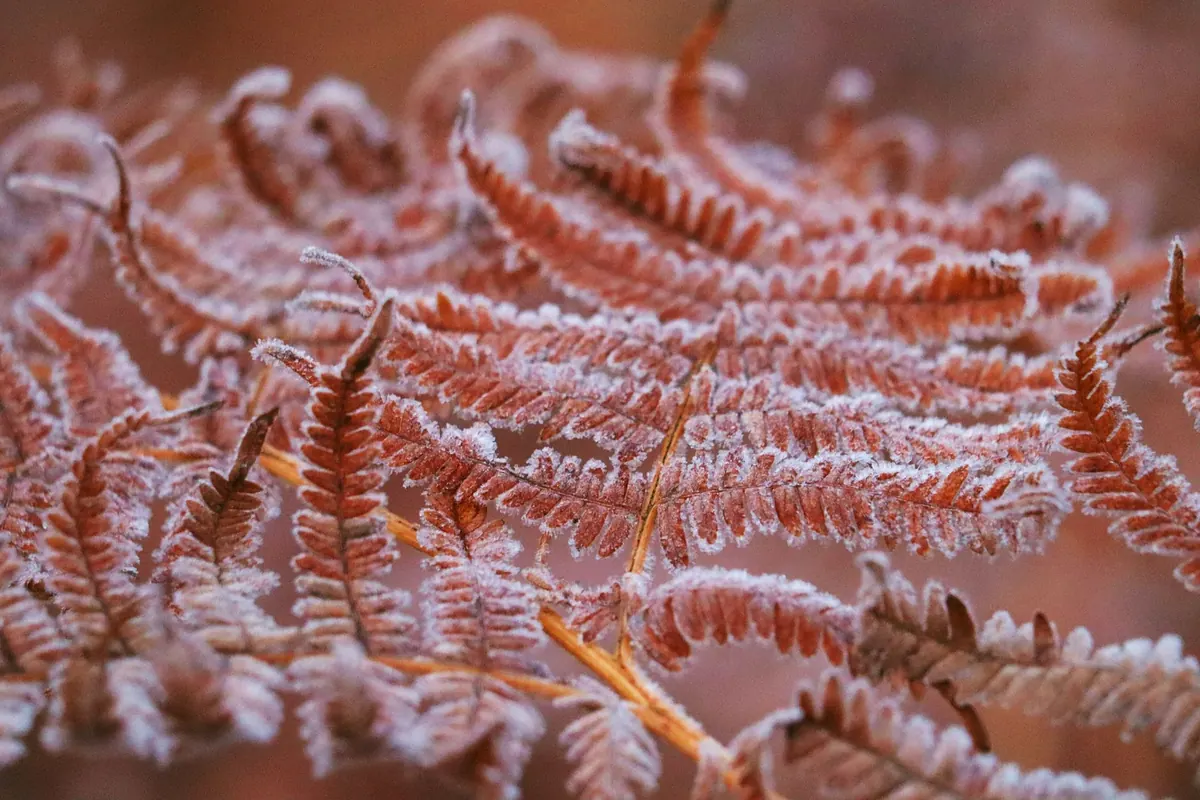
Hardy garden ferns such as Dryopteris, Polystichum and hart's tongue cope with British cold well. What kills them is wet, not frost. Clear fallen leaves from the crown so it can breathe, and lift pots onto feet so they are not sitting in puddles. Don't cut back evergreen fronds yet — leave them through the worst of the weather and tidy in early spring as new croziers unfurl. Tender ferns in pots can be moved against a sheltered wall, with the pot wrapped in bubble wrap or hessian to protect the roots.
Expect ferns to look slightly thinner by February. That is normal in a British winter, and it is not a sign you have failed. Resist the urge to repot, divide or hard-prune now; wait until growth restarts, usually in March or April, when the plant has the light and energy to recover. Keep the weekly rhythm going, and as the days lengthen, gradually increase water and begin feeding again. Come spring you will have a fern that is ready to grow, not one that has spent the winter drowning.
Photo: Nikola Tomašić / Pexels